
Fast five with the Committee for Melbourne
For over 30 years, XeP3 has been driving innovation and process re-engineering across industries around the world.
Welcome to another edition of Fast Five – our series where we ask influential and exceptional leaders five questions to get a behind-the-scenes look at some of Australia’s most dynamic organisations.
XeP3 is the revolutionary tool that creates capacity, takes out cost, and improves an organisation’s process performance. Bevington Partners are the people behind the power and they now have their sights set on global growth. The company’s commitment to excellence is reflected in its long-standing academic partnerships and contributions to research with esteemed institutions.
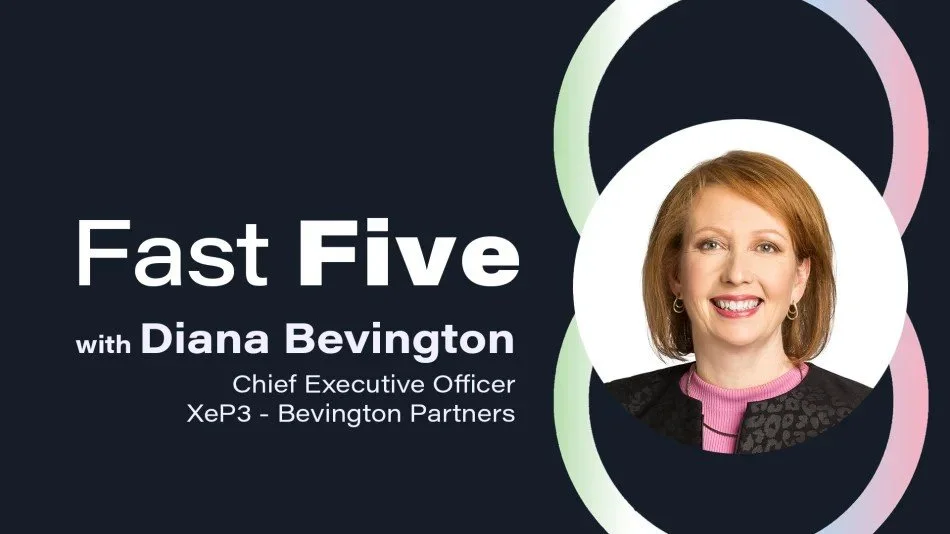
In this edition we speak to CEO, Diana Bevington.
Diana is a highly respected leader in operational performance and management, with over 30 years of executive consulting experience spanning healthcare, petrochemicals, retail, banking, and numerous other sectors. As the co-founder of the digitised XeP3 methodology, she has played a pivotal role in transforming large and complex operations for greater efficiency and impact like hospitals, multi-nation supply chains, and telecomms. Diana is a trusted advisor to organisations seeking sustainable performance improvements. She is a guest lecturer with the University of Melbourne and the co-author of Solving the Paradox of Lean Management’s Low Success Rate, published in the Australian Journal of Management.
1. What is XeP3 and what is your process noise level?
XeP3 is the only process transformation platform that directly helps organisations to create capacity, reduce cost, and improve customer service. XeP3 is guaranteed to deliver process performance and bottom-line improvements and has proven it at 113+ organisations in Asia, Australia, Europe and North/Central America covering industries including banking and finance, healthcare, petro-chemicals, education, retail, logistics, and many more.
Your process noise level is the quantified sum of staff effort lost to waste. Correcting errors, duplicated checking, chasing, completing unfinished work, and the consequences of failures – and so much more. If you can know your noise level and what drives it, you can address it and create operational capacity and improve your bottom line.
2. How does Bevington Partners work with clients to achieve improved process results – from short term to long term?
Bevington Partners trains continuous improvement teams to deliver process improvement with the XeP3 tool, building from fundamental Lean-thinking foundations. Our goal is to give our clients the control to make fast and sustained improvements to their processes, from core service delivery to small processes like payroll and purchasing.
Too many change projects don’t prove their ROI or trail off without any real tangible outcomes to celebrate. We train your leaders to use XeP3 to analyse performance results, agree the right process changes, and to drive measures-led implementation that prioritises proving your benefits are real.
3. What is the research or logic behind the XeP3 tool?
Eighty per cent of big improvement projects fail. In Feb 2025, the University of Melbourne published a paper explaining the Lean paradox and why a concept as ubiquitous as Lean is rarely successful. The academic team found that the stand-out method to guarantee success was using XeP3. From a review of over 200 projects, the paper found XeP3 delivered real benefits to large process projects.
The success comes from the digitised method’s focus on detail, genuine staff engagement, and building a data-led benefits model.
Read for yourself: Samson, D., Ho, W., Seyedghorban, Z., Bevington, D., & Kelly, S. (2025). Solving the paradox of Lean Management’s low success rate. Australian Journal of Management
4. What are some examples or success stories that best illustrate such productivity gains?
A leading Cancer Hospital reduced its time for patients to get a CT scan from 29 days to 24 hours – and saved $500,000 per annum too
A national delivery operator used XeP3 in its customer billing team to halve its complaint handling time – improving the customer experience and cost to serve
A regional nursing network used XeP3 to increase billable hours in its staff by 5-10 per cent and cut 20 per cent of its cost-to-serve
A retail distribution centre used XeP3 to reduce avoidable cost to damaged and returned goods by 80 per cent and double the turnover speed of units in the distribution centres.
5. What is the future of process excellence and continuous improvement?
As organisations increasingly automate processes and introduce AI agent servicing, it becomes increasingly important to benchmark performance and to maintain visibility of what the customer values and where we fail to deliver that.
Consulting is being replaced by internal improvement capability – which, if not supported by the right tools, can become a false economy and only yield disruption and momentum-sapping projects that never actually deliver anything.
But – with the right tools, organisations create their own improvement and have a far more engaged workforce – and happier customer.
This article has been shared by the Committee for Melbourne as it showcases members with women in leadership. Read the full article here.